
Multi-Disciplinary Research Council.
Orchid University encourages students and scholars to expand human knowledge through analysis, innovation and insight across disciplines — aligned with the National Education Policy (NEP) 2020.

Orchid University encourages students and scholars to expand human knowledge through analysis, innovation, and insights in multi-disciplinary courses impacting projects nationwide. Aligned with the National Education Policy (NEP) 2020, the Multi-Disciplinary Research Council (MDRC) signifies the transformative shift in India's educational framework by emphasising multidisciplinary and holistic learning.
Historically, India's doctoral education system has been characterised by rigid disciplinary boundaries, with students expected to specialise early in their academic careers. The MDRC dissolves those boundaries — creating a single institutional home for advanced inquiry across every domain.
A centralised hub for advanced inquiry.
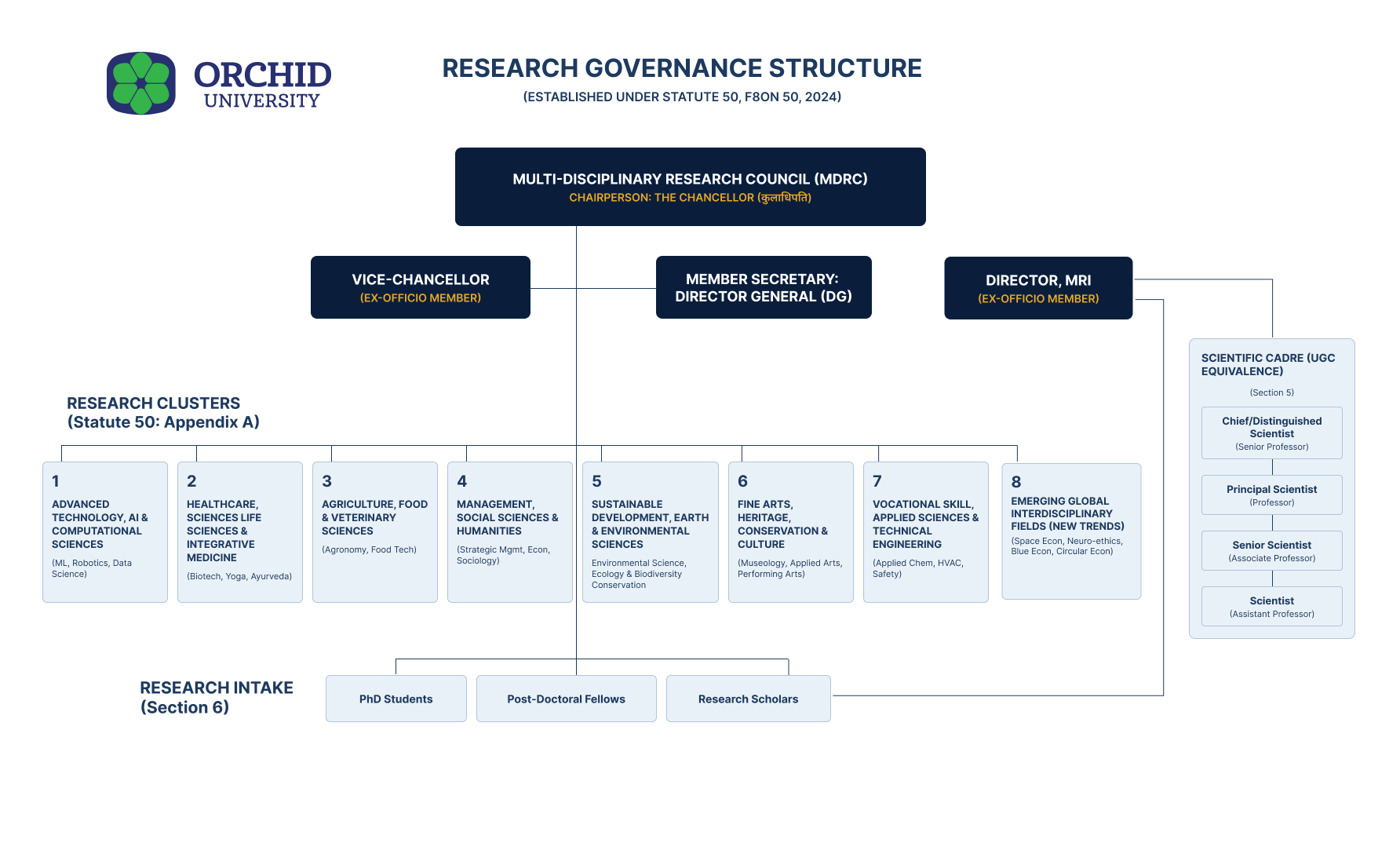
Pursuant to Section 8(7) of the Orchid University Act, 2024, the University establishes the Multi-Disciplinary Research Council (MDRC) as the centralised institutional hub for all advanced scientific and academic inquiry. The MDRC integrates research activities across all academic domains, including but not limited to:

Rigour, synthesis and global alignment.
The MDRC explores the new paradigms of multidisciplinary education introduced by NEP 2020 — for students, educators and researchers.
Standardisation
Research output is evaluated against UGC-NET/JRF (Humanities/Management), CSIR-NET/GATE (Science/Engineering) and ICAR-NET (Agriculture/Veterinary) standards to ensure academic rigour and national relevance.
Interdisciplinary Synthesis
Every project seeks at least one "Interdisciplinary Nexus" — scholars from two distinct clusters collaborate to provide holistic solutions to complex problems.
Global Alignment
Methodologies adhere to SCOPUS/WoS indexing standards, promoting collaborative research with international academic entities and a global research footprint.
Scholars, scientists, principal investigators.
All PhD and Post-Doctoral scholars admitted are classified into clusters based on their core research domain.
The Scientific Cadre — from Scientists to Distinguished Scientists — acts as Principal Investigators (PIs) for these clusters, ensuring all projects align with national priority sectors defined by the Government of India and the global Sustainable Development Goals (SDGs).

A rigorous research cadre.
The Institute maintains a rigorous scientific cadre structure for its full-time researchers, modelled on the following hierarchy:
Scientist
Entry-level research cadre.
Senior Scientist
Mid-level research and project leadership.
Principal Scientist
Senior research, administrative oversight and laboratory management.
Chief / Distinguished Scientist
Apex-level research excellence and institutional policy guidance.
Cadres mapped to faculty status.
For academic progression, faculty status and university-wide integration, the following equivalence is established — adhering to UGC guidelines and the Career Advancement Scheme (CAS):
Note: Promotion to these cadres is strictly subject to the fulfilment of research output, teaching experience and Academic Performance Indicators (API) as prescribed by UGC Regulations.
How scholars join the MDRC.
PhD Admissions
Conducted in strict compliance with the UGC (Minimum Standards and Procedures for Award of PhD Degree) Regulations — a qualifying entrance examination and a rigorous interview process.
Post-Doctoral Fellows (PDF)
Intake through national/international fellowship programmes or an independent competitive selection process instituted by the Council.
Research Assistantship
All Research Scholars are eligible for stipends and resource allocations as per prevailing UGC and University norms.
Oversight, cadence and governance.
Oversight
Operates under the administrative control of the Director General (DG) and the strategic policy framework of the MDRC.
Meetings & Quorum
Convenes at least once every quarter. One-third (1/3) of total membership forms the quorum for any MDRC meeting.
Reporting
Periodic research outcomes, publications and financial audit reports are submitted to the MDRC, which apprises the Board of Management and the Governing Body.
Pursue research that matters.
Explore doctoral clusters, fellowships and collaboration at Orchid University.